SOCKS5 proxies
Private SOCKS5 proxies with TCP and UDP support.
SOCKS5 proxy plans
Every plan includes IPv4 and SOCKS5 together, at no extra cost.
Threads are simultaneous connections. The more threads, the higher the parallel load your software can handle.

Pool of 12,000-15,000 IPs
Address rotation
Unlimited traffic
Up to 1,000 threads

Pool of 12,000-15,000 IPs
Address rotation
Unlimited traffic
Up to 1,000 threads

Pool of 12,000-15,000 IPs
Address rotation
Unlimited traffic
Up to 1,000 threads

Pool of 12,000-15,000 IPs
Address rotation
Unlimited traffic
Up to 1,000 threads
Pool of 12,000-15,000 IPs
Address rotation
Unlimited traffic
Up to 3,000 threads
Pool of 12,000-15,000 IPs
Address rotation
Unlimited traffic
Up to 3,000 threads
Pool of 12,000-15,000 IPs
Address rotation
Unlimited traffic
Up to 3,000 threads
Pool of 12,000-15,000 IPs
Address rotation
Unlimited traffic
Up to 3,000 threads
Proxy catalog for your task
Why you need SOCKS5 proxies
SOCKS5 is a universal transport-level protocol that passes different traffic types and does not interfere with the data. It is handy for software and non-standard connections where plain HTTP is not enough.
SOCKS5 does not inspect what travels through it, it simply forwards the connection, so mail clients, messengers and any software that speaks to a socket work through it. HTTP proxies understand web traffic and nothing else, which is why automation setups usually settle on SOCKS5.
Features of SOCKS5 proxies
SOCKS5 works at the transport level and carries any TCP traffic beyond the web: Telegram, games, torrents, mail clients, SSH and curl. So it is taken where an HTTP proxy does not fit.
The pool hands over private IPv4 by SOCKS-4 or SOCKS-5, as IP:PORT bound to your address or IP:PORT:LOGIN:PASS. Written as socks5h, the scheme has the proxy resolve hostnames, so domain queries never leave through your own channel.
What proxies you need for SOCKS5
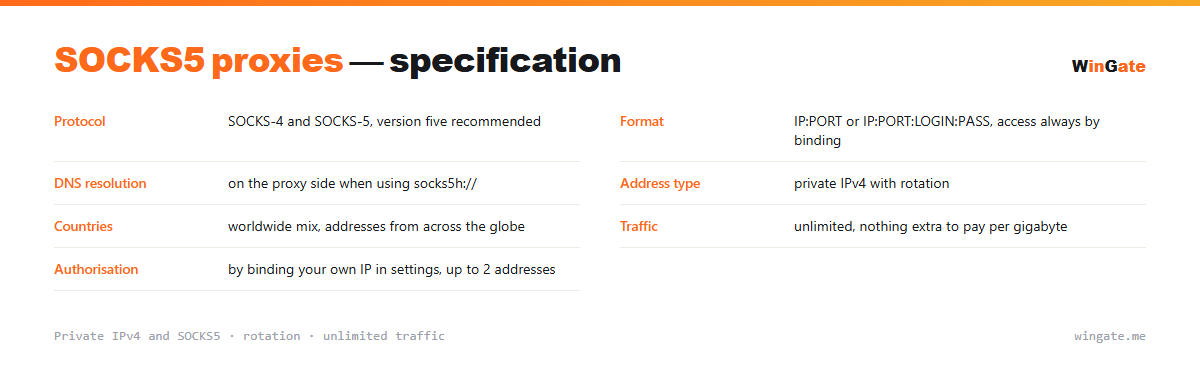
| Protocol | SOCKS-4 and SOCKS-5, version five recommended |
|---|---|
| Format | IP:PORT or IP:PORT:LOGIN:PASS, access always by binding |
| DNS resolution | on the proxy side when using socks5h:// |
| Address type | private IPv4 with rotation |
| Countries | worldwide mix, addresses from across the globe |
| Traffic | unlimited, nothing extra to pay per gigabyte |
| Authorisation | by binding your own IP in settings, up to 2 addresses |
How SOCKS5 proxies differ from HTTP
The difference sits at the protocol layer. An HTTP proxy reads the requests themselves, can attach its own service headers and only handles web traffic. SOCKS5 works one level lower, at the transport layer: it never looks inside and just passes bytes between you and the destination. That is where both the versatility and the absence of extra traces in the request come from.
One detail gets overlooked more than any other: there are two ways to write the address. With socks5:// the hostname is resolved on your machine, so the DNS query never touches the proxy and stays visible to your own provider. With socks5h:// the proxy resolves the name, and nothing leaks through your channel. When it matters which domains you are querying, the second form is the one to use.
Both protocol versions ship with the package, SOCKS-4 and SOCKS-5, but the fifth is what you want: version four supports neither login and password authentication, nor IPv6, nor UDP. If your software handles HTTP and SOCKS5 alike, you will not notice a speed difference between them, though SOCKS5 wins on compatibility.
On the software side the setup comes down to three fields: address, port and, where the format carries them, a login and password. Browser profiles and anti-detect shells pick the connection type from a list, and the same screen usually holds a checkbox for resolving names on the proxy side. Where that box is missing and domains should not leak, the connection is raised through a local client that speaks socks5h.
- socks5h:// resolves hostnames on the proxy side, socks5:// on yours
- SOCKS adds no service headers, unlike some HTTP proxies
- SOCKS-4 cannot do login and password authentication
- Any TCP traffic passes through SOCKS5
How to set up SOCKS5 proxies
Access is granted by binding your IP in the personal cabinet (up to 2 addresses); without it the proxy will not work in any format. SOCKS5 is set in the application or system settings: SOCKS5 type, address and port. Suitable for browsers, antidetects, Telegram, SSH and curl.
For software that needs login and password fields, there is an additional IP:PORT:LOGIN:PASS format. SOCKS5 compatibility with your application is easy to check on the free test.
How to buy SOCKS5 proxies
The process is simple. Register in the dashboard and request a free test up to 2 hours, bind your IP and message the operator in a ticket to check the work on your own tasks.
When everything fits, pick a package by volume and term, pay in cryptocurrency, and access opens right after payment. The test is provided once before purchase, and support replies in a ticket.
FAQ
How does SOCKS5 differ from HTTP?
SOCKS5 works at the connection level and passes different traffic types, while HTTP is tailored to web requests. Both are available on one address, which is easier to see on the test.
Do I need a login and password?
Access opens by binding your IP in the cabinet, up to 2 addresses. Login and password is only an additional output format for software with those fields. Both methods can be checked on the free test before purchase.
Can I choose the address country?
The work uses a pool of private IPv4 with rotation, drawn from networks worldwide. Whether this fits your task is visible on the free test.
See also: IPv4 proxies, HTTP/HTTPS proxies, buy proxies for A-Parser, buy proxies for Screaming Frog, buy proxies for Netpeak Spider, buy proxies for Key Collector, buy proxies for Dolphin Anty, buy proxies for AdsPower, full catalog
© WinGate · source of the material · wingate.me/en/proxy/socks5-proxy