Proxies for parsing
Private SOCKS5 proxies tuned for data collection at scale.
Proxy plans for parsing
Every plan includes both IPv4 and SOCKS5.
Threads are simultaneous connections. The more threads, the higher the parallel load your software can handle.

Pool of 12,000-15,000 IPs
Address rotation
Unlimited traffic
Up to 1,000 threads

Pool of 12,000-15,000 IPs
Address rotation
Unlimited traffic
Up to 1,000 threads

Pool of 12,000-15,000 IPs
Address rotation
Unlimited traffic
Up to 1,000 threads

Pool of 12,000-15,000 IPs
Address rotation
Unlimited traffic
Up to 1,000 threads
Pool of 12,000-15,000 IPs
Address rotation
Unlimited traffic
Up to 3,000 threads
Pool of 12,000-15,000 IPs
Address rotation
Unlimited traffic
Up to 3,000 threads
Pool of 12,000-15,000 IPs
Address rotation
Unlimited traffic
Up to 3,000 threads
Pool of 12,000-15,000 IPs
Address rotation
Unlimited traffic
Up to 3,000 threads
Proxy catalog for your task
Why you need proxies for parsing
Parsing means collecting data from websites at scale, and when a lot of requests come from one address, sites quickly show a captcha and slow you down.
Scraping from a single address quickly runs into request limits. Once that frequency crosses a site's limit, you start getting captchas and empty pages, so the load is spread across the pool and no single IP carries it all.
Features of proxies for parsing
When you scrape in many threads, almost any site starts showing captchas and limiting requests after a burst of requests from one IP. So a parser needs a pool where each thread or batch of requests runs from its own address.
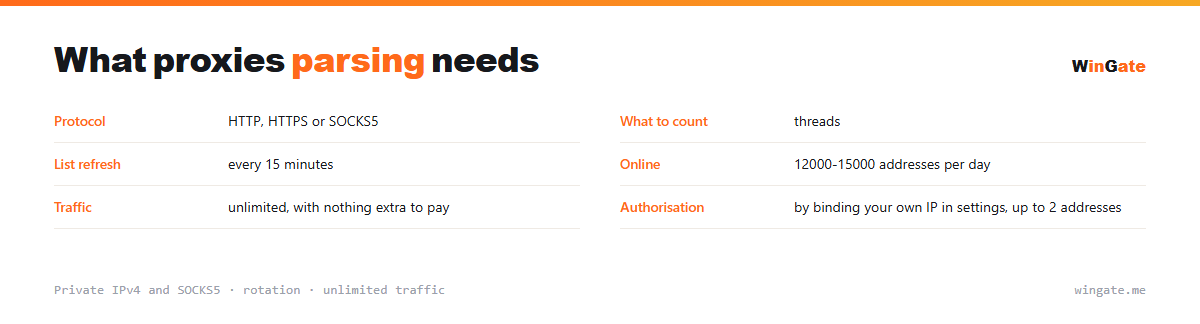
You get private IPv4 over HTTP, HTTPS or SOCKS5, as IP:PORT bound to your IP or as IP:PORT:LOGIN:PASS, with 12,000-15,000 IPs online per day. The number of addresses depends on how many threads you run at once, and the list refreshes every 15 minutes.
What proxies you need for parsing
| Protocol | HTTP, HTTPS or SOCKS5 |
|---|---|
| What to count | threads |
| List refresh | every 15 minutes |
| Online | 12,000-15,000 IPs online daily |
| Traffic | unlimited |
| Authorization | by binding your own IP in settings, up to 2 addresses |
How many proxies you need for parsing
Start with your thread count. Run 50 threads on 10 addresses and each IP gets five times the requests, so it is blocked first and drags the overall speed down. Do it the other way round, with more addresses than threads, and you keep the pace without overloading any single IP.
The second factor is request timing. Intervals that are identical down to a fraction of a second look like automation even when every request comes from a different address, so randomize your pauses. Headers have to match too: the browser named in your headers must match the connection fingerprint, otherwise changing the IP will not help.
To check the list on its own, you can use the ZennoLab proxy checker, which has a demo version. Similar techniques are covered on the page about price tracking.
- Match the number of addresses to your threads
- Perfectly even intervals give away automation, even with rotation
- Headers must match the connection fingerprint
How to set up proxies for parsing
To connect to the pool, go to the settings and bind the IP of the server or home computer where your proxy software runs. Without this binding the proxies will not work. There are two formats: the standard IP:PORT and IP:PORT:LOGIN:PASS for programs that need login and password fields.
In a parser, proxies are added as a list in the settings or in code, in IP:PORT format, HTTP or SOCKS5, and distributed across threads.
Check the list before a big run. The free test shows how many addresses your thread count needs.
How to buy proxies for parsing
The process is simple. Sign up in the dashboard, request a free test of up to 2 hours, bind your IP and message support through a ticket to check the setup on your own parsing tasks.
If everything works, choose a package by volume and term, pay in crypto, and access opens right after payment. Before buying, you can run the free test once. Support replies to tickets.
FAQ
Will these proxies work for parsing?
For data collection you can use HTTP, HTTPS or SOCKS5 in IP:PORT format, rotating addresses on each request. The free test shows the speed and whether it fits your task.
How many threads can I run?
The thread limit and the number of bound IPs depend on the package, and the pool of 12,000-15,000 IPv4 addresses gives parallel requests different IPs.
Which protocol should I choose, HTTP or SOCKS5?
For most parsing tasks either one works; SOCKS5 is better for non-standard connections. You can check both during the free test.
See also: buy proxies for A-Parser, buy proxies for Screaming Frog, buy proxies for Netpeak Spider, buy proxies for Key Collector, buy proxies for price monitoring, buy proxies for SEO, IPv4 proxies, buy proxies for Xevil, full catalog
© WinGate · source of the material · wingate.me/en/proxy/parsing-proxy