Proxies for SEO
Private proxies for SEO.
Proxy plans for SEO
Every plan includes both IPv4 and SOCKS5.
Threads are simultaneous connections. The more threads, the higher the parallel load your software can handle.

Pool of 12,000-15,000 IPs
Address rotation
Unlimited traffic
Up to 1,000 threads

Pool of 12,000-15,000 IPs
Address rotation
Unlimited traffic
Up to 1,000 threads

Pool of 12,000-15,000 IPs
Address rotation
Unlimited traffic
Up to 1,000 threads

Pool of 12,000-15,000 IPs
Address rotation
Unlimited traffic
Up to 1,000 threads
Pool of 12,000-15,000 IPs
Address rotation
Unlimited traffic
Up to 3,000 threads
Pool of 12,000-15,000 IPs
Address rotation
Unlimited traffic
Up to 3,000 threads
Pool of 12,000-15,000 IPs
Address rotation
Unlimited traffic
Up to 3,000 threads
Pool of 12,000-15,000 IPs
Address rotation
Unlimited traffic
Up to 3,000 threads
Proxy catalog for your task
Why you need proxies for SEO
SEO relies on collecting rankings, search suggestions and SERPs at scale. When requests come from one address, search engines quickly ask for a captcha and collection stops.
When you pull results and check rankings, the search engine quickly notices repeated queries from one address and starts showing captchas. A pool fixes that by spreading the load: each query goes out from its own IP.
Features of proxies for SEO
In SEO, proxies are needed for rank tracking, keyword research, competitor analysis and link audits, where tools send large numbers of automated queries to search engines. From one IP, this quickly runs into a captcha.
You get private IPv4 over HTTP, HTTPS or SOCKS5, as IP:PORT bound to your IP or as IP:PORT:LOGIN:PASS, with 12,000-15,000 IPs online per day. Queries are spread across the pool, and the number of addresses depends on how many threads your tool runs at once.
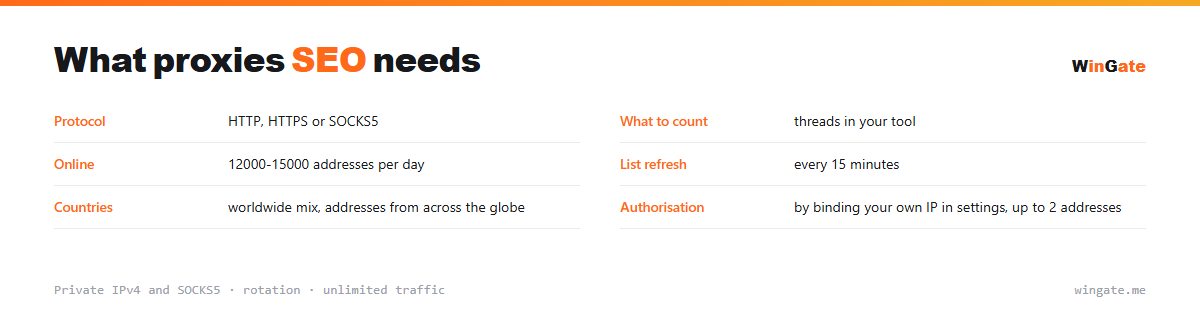
What proxies you need for SEO
| Protocol | HTTP, HTTPS or SOCKS5 |
|---|---|
| What to count | threads in your tool |
| Online | 12,000-15,000 IPs online daily |
| List refresh | every 15 minutes |
| Countries | worldwide mix of countries |
| Authorization | by binding your own IP in settings, up to 2 addresses |
What breaks rank checking and how SEO proxies help
The first thing people trip over is frequency. A search engine allows only a certain number of queries per address in a given time, and that limit is lower than most people expect, especially when you pull deep result pages. So the number of addresses is based on how many threads your tool runs at once.
The second is repetition. Queries sent at even intervals with identical headers stand out from real ones even when the address changes, so randomize the pauses. Most SEO software can do this, but the setting is usually left at its default.
The third is geography. Tool-specific notes are on the pages about Key Collector and A-Parser.
- Search engine rate limits are lower than you might expect
- The number of addresses depends on the thread count in your tool
- The pause randomization setting is usually left at its default
- Countries are mixed, so check regional results on the free test
How to set up proxies for SEO
Access opens once you bind your IP in the settings. That is the address of the server or home computer where your software runs; without it, nothing will connect. It comes in two formats: IP:PORT as the main one, and IP:PORT:LOGIN:PASS for programs with login and password fields.
For SEO, proxies are loaded into tools (Key Collector, A-Parser, Netpeak, Screaming Frog) as a list in IP:PORT format, HTTP or SOCKS5, and distributed across threads.
Check the list before you start collecting. The free test will show how many addresses you need for your SEO tasks.
How to buy proxies for SEO
The process is simple. Sign up in the dashboard, request a free test of up to 2 hours, bind your IP and message support through a ticket to check the setup on your own SEO tasks.
If everything works for you, choose a package by volume and term, pay in crypto, and access is activated automatically. Before buying, you can run the free test once. Support replies to tickets.
FAQ
Will these proxies work for SEO?
For collecting rankings and suggestions, HTTP, HTTPS and SOCKS5 in IP:PORT format all work, with addresses rotating on every query. The free test shows whether it fits.
Do I need a captcha-solving service?
For mass scraping, proxies paired with a captcha-solving service run noticeably smoother; the service is connected separately. The test shows how collection goes.
Are there enough addresses for large-scale scraping?
The pool of 12,000-15,000 IPv4 with rotation provides new addresses for frequent queries; the number of threads depends on the package.
See also: proxies for SEO software and automation, proxies for Xrumer, proxies for GSA Search Engine Ranker, proxies for Doorway Generator, proxies for Google, proxies for Yandex, proxies for AMS Enterprise, proxies for price monitoring, full catalog
© WinGate · source of the material · wingate.me/en/proxy/seo-proxy