Proxies for Yandex
Private proxies for Yandex.
Proxy plans for Yandex
Every plan includes both IPv4 and SOCKS5.
Threads are simultaneous connections. The more threads, the higher the parallel load your software can handle.

Pool of 12,000-15,000 IPs
Address rotation
Unlimited traffic
Up to 1,000 threads

Pool of 12,000-15,000 IPs
Address rotation
Unlimited traffic
Up to 1,000 threads

Pool of 12,000-15,000 IPs
Address rotation
Unlimited traffic
Up to 1,000 threads

Pool of 12,000-15,000 IPs
Address rotation
Unlimited traffic
Up to 1,000 threads
Pool of 12,000-15,000 IPs
Address rotation
Unlimited traffic
Up to 3,000 threads
Pool of 12,000-15,000 IPs
Address rotation
Unlimited traffic
Up to 3,000 threads
Pool of 12,000-15,000 IPs
Address rotation
Unlimited traffic
Up to 3,000 threads
Pool of 12,000-15,000 IPs
Address rotation
Unlimited traffic
Up to 3,000 threads
Proxy catalog for your task
Why you need proxies for Yandex
SEO specialists collect rankings, search suggestions and results pages from Yandex. With mass queries from one address, the search engine soon asks for a captcha and scraping stops.
Yandex is stricter than Google about request rate and shows its captcha sooner under the same load. It also checks the region in the request against the location of the IP, so the pool matters both for spreading the load and for getting an IP in the right place.
Features of proxies for Yandex
Yandex services are quick to show a captcha on automated queries: scraping results, collecting suggestions or working with Wordstat from one IP hits limits after a few dozen requests. You need a pool that spreads queries across addresses.
You get private IPv4 over HTTP, HTTPS or SOCKS5, as IP:PORT bound to your IP or as IP:PORT:LOGIN:PASS, with 12,000-15,000 IPs online per day. Queries are spread across the pool, and the number of addresses depends on how many threads your tool runs at once.
What proxies you need for Yandex
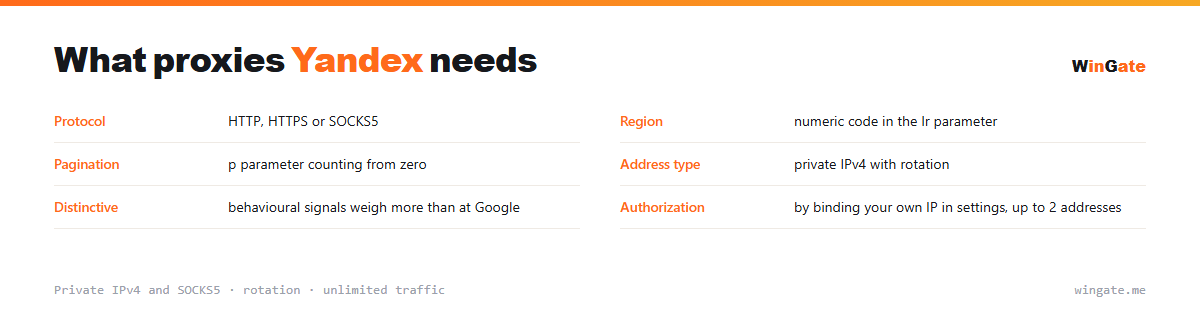
| Protocol | HTTP, HTTPS or SOCKS5 |
|---|---|
| Region | numeric code in the lr parameter |
| Pagination | p parameter counting from zero |
| Address type | private IPv4 with rotation |
| What sets it apart | behavioural signals weigh more than at Google |
| Authorization | by binding your own IP in settings, up to 2 addresses |
What to keep in mind when scraping Yandex results
The region is set by a numeric code in the lr parameter, and it changes which results show up, their order and the local blocks. This is where newcomers often get caught: Yandex checks that region code against the location of your IP. There is no point asking for Moscow results from an address on the other side of the world: the signals do not match, and the address loses trust even before a captcha appears.
Pagination uses the p parameter, which counts from zero: the first page is 0, the second is 1. Yandex does not let you go deep into the results, and chasing far pages makes little sense: lower positions are unstable and captchas come more often. To cover more, split the work into narrow queries and different regions.
Behavioural signals weigh more here than at Google. A steady machine rhythm, with requests sent at exactly equal intervals in the same order, looks like automation even from a good address, so vary the pauses and the order of requests.
- The region code is checked against the IP location
- Page counting starts from zero
- Organic results, ads and verticals are scraped separately
- Requests at even intervals get flagged even from a good address
How to set up proxies for Yandex
To connect to the pool, go to the settings and bind the IP of the server or home computer where your proxy software runs. Without this binding the proxies will not work. There are two formats: the standard IP:PORT and IP:PORT:LOGIN:PASS for programs that need login and password fields.
In Yandex scrapers (Key Collector, A-Parser, Netpeak, etc.), proxies are loaded as an IP:PORT list, HTTP or SOCKS5, and spread across query threads.
Check the list with the built-in checker before you start collecting. The free test shows how many addresses your Yandex query volume needs.
How to buy proxies for Yandex
The process is simple. Sign up in the dashboard, request a free test of up to 2 hours, bind your IP and open a ticket with the operator to check the setup for Yandex on your own tasks.
If everything works, choose a package by volume and term, pay in crypto, and access opens right after payment. The free test runs once, before you pay. Support answers in tickets.
FAQ
Will these proxies work for scraping Yandex?
For collecting rankings and suggestions, HTTP, HTTPS and SOCKS5 in IP:PORT format all work, with addresses rotating on every query. The free test shows whether it fits.
Do I need a captcha-solving service?
For mass scraping, proxies paired with a captcha-solving service run noticeably smoother; the service is connected separately. The test shows how your scraping runs.
Are there enough addresses for large-scale scraping?
The pool of 12,000-15,000 IPv4 with rotation provides new addresses for frequent queries; the number of threads depends on the package.
See also: proxies for SEO, proxies for SEO software and automation, proxies for Xrumer, proxies for GSA Search Engine Ranker, proxies for Doorway Generator, proxies for Google, proxies for Midjourney, private IPv4 proxies, full catalog
© WinGate · source of the material · wingate.me/en/proxy/yandex-proxy