Private IPv4 proxies: HTTP and SOCKS5
Private IPv4 proxies with full HTTP support.
Private IPv4 proxy plans
Every plan includes both IPv4 and SOCKS5.
Threads are simultaneous connections. The more threads, the higher the parallel load your software can handle.

Pool of 12,000-15,000 IPs
Address rotation
Unlimited traffic
Up to 1,000 threads

Pool of 12,000-15,000 IPs
Address rotation
Unlimited traffic
Up to 1,000 threads

Pool of 12,000-15,000 IPs
Address rotation
Unlimited traffic
Up to 1,000 threads

Pool of 12,000-15,000 IPs
Address rotation
Unlimited traffic
Up to 1,000 threads
Pool of 12,000-15,000 IPs
Address rotation
Unlimited traffic
Up to 3,000 threads
Pool of 12,000-15,000 IPs
Address rotation
Unlimited traffic
Up to 3,000 threads
Pool of 12,000-15,000 IPs
Address rotation
Unlimited traffic
Up to 3,000 threads
Pool of 12,000-15,000 IPs
Address rotation
Unlimited traffic
Up to 3,000 threads
Proxy catalog for your task
Why you need private IPv4 proxies
IPv4 is the basic address format that almost all sites and programs work with. A private IPv4 is not in public lists, and thousands of random people do not share it.
IPv4 is the one version every platform accepts without argument. Plenty of services either refuse IPv6 outright or treat it with extra suspicion, so scraping and automation work still runs on IPv4 addresses.
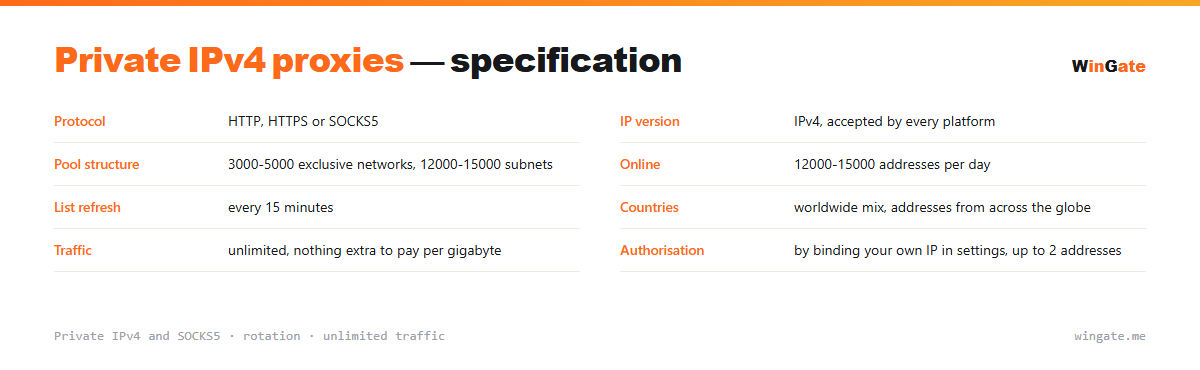
Features of private IPv4 proxies
A private IPv4 works with almost any site and program and is given to one owner, so its reputation depends only on you. It is the basic working format for scraping, accounts and automation.
You get private IPv4 over HTTP, HTTPS or SOCKS5, as IP:PORT bound to your IP or as IP:PORT:LOGIN:PASS. Bulk jobs are spread across the pool, and anything behind a login stays on one fixed IP.
What to look for in private IPv4 proxies
| Protocol | HTTP, HTTPS or SOCKS5 |
|---|---|
| IP version | IPv4, accepted by every platform |
| Pool structure | 3000-5000 exclusive networks, 12000-15000 subnets |
| Online | 12,000-15,000 IPs online daily |
| List refresh | every 15 minutes |
| Countries | worldwide mix of countries |
| Traffic | unlimited |
| Authorization | by binding your own IP in settings, up to 2 addresses |
Why tasks run on private IPv4 proxies
The choice between versions is simple: IPv6 is cheaper and far more plentiful, but not every site accepts it. Many services either do not respond to IPv6 at all or treat it as suspicious by default, because a disproportionate share of automated traffic comes from IPv6. IPv4 has none of these issues and simply works.
The second question is who else uses the addresses. Public lists are used by thousands of people at once, scraped by other services and resold as their own, so an address from such a list is often blocked before you send your first request. A private pool is used by a small circle of clients, so an address does not carry a history from all over the internet.
Pool structure matters as much as pool size. With addresses spread across subnets, the IPs in your rotation do not look like one solid block, and that is exactly what anti-bot systems check when deciding whether they see real visitors or one client with a range.
Before real work, it pays to check more than whether an address simply responds. Check which country and provider an IP lookup service shows for the address, because some platforms react to the network type. To check a whole list, you can use the ZennoLab proxy checker, which has a demo version.
- Some services will not accept IPv6 at all
- A public address is often flagged before your first request
How to set up private IPv4 proxies
Access works by binding your IP in the dashboard (up to 2 addresses); without that, the proxies will not work in any format. A private IPv4 proxy works with any software: you just enter the address, port and protocol, HTTP or SOCKS5.
For software that needs a login and password, there is also the IP:PORT:LOGIN:PASS format. The free test lets you see how IPv4 works for your task before you buy.
How to buy private IPv4 proxies
The process is simple. Sign up in the dashboard, request a free test of up to 2 hours, bind your IP and open a ticket with an operator to see how the proxies work on your own tasks.
Select a package for your volume and term, complete the crypto payment, and the proxies become available as soon as it clears. You get one free test before you buy, and support replies in tickets.
FAQ
How do private IPv4 proxies differ from shared ones?
Random people do not use a private address, so the work is more predictable. The free test will show how your task runs.
Should I choose HTTP or SOCKS5?
Both work on the same IPv4 address; for most tasks either one is fine, and SOCKS5 is better for non-standard connections. You can check both during the free test.
Can I choose the address country?
You get a rotating pool of private IPv4 from networks around the world. The free test shows whether this fits your task.
See also: private SOCKS5, HTTP/HTTPS proxies, buy proxies for A-Parser, buy proxies for Screaming Frog, buy proxies for Netpeak Spider, buy proxies for Key Collector, buy proxies for AdsPower, buy proxies for Dolphin Anty, full catalog
© WinGate · source of the material · wingate.me/en/proxy/proxy-private-ipv4