Proxies for mining
Private proxies for mining and pool connections.
Proxy plans for mining
Every plan includes both IPv4 and SOCKS5.
Threads are simultaneous connections. The more threads, the higher the parallel load your software can handle.

Pool of 12,000-15,000 IPs
Address rotation
Unlimited traffic
Up to 1,000 threads

Pool of 12,000-15,000 IPs
Address rotation
Unlimited traffic
Up to 1,000 threads

Pool of 12,000-15,000 IPs
Address rotation
Unlimited traffic
Up to 1,000 threads

Pool of 12,000-15,000 IPs
Address rotation
Unlimited traffic
Up to 1,000 threads
Pool of 12,000-15,000 IPs
Address rotation
Unlimited traffic
Up to 3,000 threads
Pool of 12,000-15,000 IPs
Address rotation
Unlimited traffic
Up to 3,000 threads
Pool of 12,000-15,000 IPs
Address rotation
Unlimited traffic
Up to 3,000 threads
Pool of 12,000-15,000 IPs
Address rotation
Unlimited traffic
Up to 3,000 threads
Proxy catalog for your task
Why you need proxies for mining
In mining you connect workers to pools and manage several rigs. A stable connection and a separate address keep the link to the pool steady.
Mining software keeps a permanent connection to the pool, and what matters here is that the connection does not drop. In that setup, a proxy hides the rig's IP and gets around network restrictions on reaching the pool.
Features of proxies for mining
In mining, proxies connect workers to pools and separate several accounts so they do not get linked by IP. A stable connection matters more than speed: every drop cuts a worker's output.
You get private IPv4 over SOCKS5, as IP:PORT bound to your IP or as IP:PORT:LOGIN:PASS. Every rig keeps its own pinned IP, and the number of addresses follows the number of persistent connections.
What proxies you need for mining
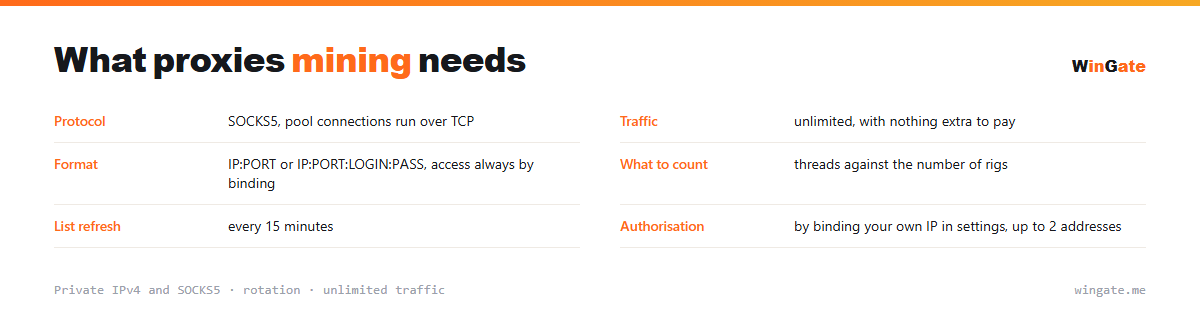
| Protocol | SOCKS5 (pool connections run over TCP) |
|---|---|
| Traffic | unlimited |
| Format | IP:PORT or IP:PORT:LOGIN:PASS, access via IP binding only |
| What to count | threads matched to the number of rigs |
| List refresh | every 15 minutes |
| Authorization | by binding your own IP in settings, up to 2 addresses |
Which proxies mining and pool connections need
The load profile is unusual: very little traffic, but the connection stays up for hours and a drop costs more than latency. So pick a package by thread count, with each rig on its own IP.
The protocol is SOCKS5, because pool connections run over their own protocol on top of TCP, and an HTTP proxy will not carry that. The format depends on your software: if it has login and password fields, use the login and password format; if not, bind your own IP in the dashboard settings.
The list refreshes every 15 minutes, so for long-running connections use the login and password format and pin one IP to each rig. Rotation is useful where the address is meant to change, as in data collection. A persistent connection keeps the same IP.
- Connection stability matters more than bandwidth
- Pool connections run over TCP, so SOCKS5 is required
- Each rig keeps its own pinned IP; rotation gets in the way
- Pick the package by thread count
How to set up proxies for mining
To connect to the pool, go to the settings and bind the IP of the server or home computer where your proxy software runs. Without this binding the proxies will not work. There are two formats: the standard IP:PORT and IP:PORT:LOGIN:PASS for programs that need login and password fields.
For mining, set the proxy in the worker or rig pool connection settings or in the system settings: IP:PORT format, HTTP or SOCKS5.
Check the connection before you put it into regular use. You can check connection stability for your workers on the free test.
How to buy proxies for mining
The process is simple. Sign up in the dashboard, request a free test of up to 2 hours, bind your IP and open a ticket with an operator to check the setup for mining on your own tasks.
If everything works, choose a package by volume and term, pay in crypto, and access opens right after payment. You can take the free test once, before you buy. If you have questions, open a ticket.
FAQ
Will these proxies work for mining?
For connecting to pools and managing rigs, HTTP, HTTPS and SOCKS5 in IP:PORT format all work. The free test shows whether it fits and what the ping is.
Is the connection stable?
At the core is a private IPv4 pool with low ping and rotation, and a separate address is used for a steady connection. You can check this during the test.
Which protocol should I choose, HTTP or SOCKS5?
Both work for most tasks; SOCKS5 is handier for non-standard connections. You can check both during the free test.
See also: buy proxies for traffic arbitrage, buy proxies for trading, buy proxies for airdrops, buy proxies for email campaigns, buy proxies for Telegram, buy proxies for Instagram, buy proxies for checkers, buy proxies for Steam, full catalog
© WinGate · source of the material · wingate.me/en/proxy/mining-proxy