Proxies for checkers
Private addresses for multi-threaded checkers.
Proxy plans for checkers
Every plan includes both IPv4 and SOCKS5.
Threads are simultaneous connections. The more threads, the higher the parallel load your software can handle.

Pool of 12,000-15,000 IPs
Address rotation
Unlimited traffic
Up to 1,000 threads

Pool of 12,000-15,000 IPs
Address rotation
Unlimited traffic
Up to 1,000 threads

Pool of 12,000-15,000 IPs
Address rotation
Unlimited traffic
Up to 1,000 threads

Pool of 12,000-15,000 IPs
Address rotation
Unlimited traffic
Up to 1,000 threads
Pool of 12,000-15,000 IPs
Address rotation
Unlimited traffic
Up to 3,000 threads
Pool of 12,000-15,000 IPs
Address rotation
Unlimited traffic
Up to 3,000 threads
Pool of 12,000-15,000 IPs
Address rotation
Unlimited traffic
Up to 3,000 threads
Pool of 12,000-15,000 IPs
Address rotation
Unlimited traffic
Up to 3,000 threads
Proxy catalog for your task
Why you need proxies for checkers
Checkers verify data and account status in bulk, which means hundreds or thousands of requests in a row. From one address sites quickly set limits and checking stops.
Checks are many short uniform requests against one service, and it is the uniformity that gives them away. A pool lets you hold a low rate on each address while keeping overall speed high.
What to know about proxies for checkers
Checkers run thousands of login-password pairs across many threads, and any service limits and blocks an IP after a few attempts. That is why a checker needs a large rotating pool, with each thread running from its own address.
You get private IPv4 over HTTP, HTTPS or SOCKS5, as IP:PORT bound to your IP or as IP:PORT:LOGIN:PASS, with 12,000-15,000 IPs online per day. Short, frequent checks get an address blocked by sheer request volume, so spread them across the pool.
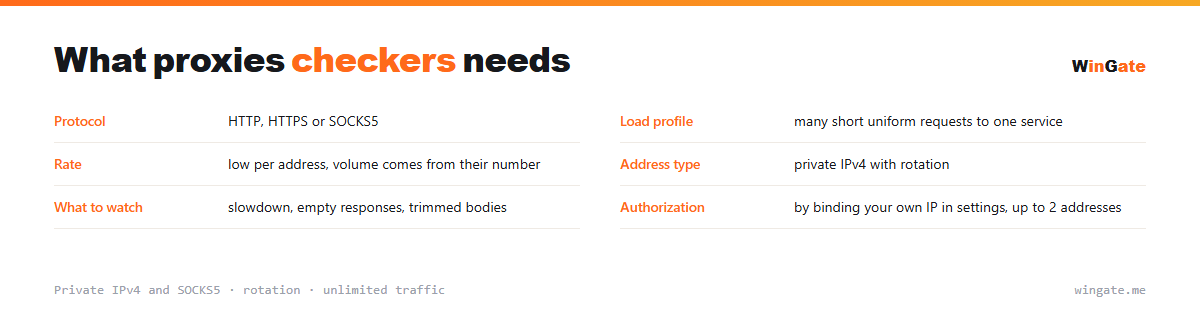
What proxies you need for checkers
| Protocol | HTTP, HTTPS or SOCKS5 |
|---|---|
| Load profile | many short uniform requests to one service |
| Rate | low per address, with volume coming from the number of addresses |
| Address type | private IPv4 with rotation |
| What to watch | slowdown, empty responses, trimmed bodies |
| Authorization | by binding your own IP in settings, up to 2 addresses |
Setting up proxies for a checker without blocks
The load profile here is distinctive: requests are short, identical in shape and aimed at the same service. A service spots that pattern faster than a simple high request rate, so the first step is to lower the rate per address and get speed from the number of addresses.
Services almost always warn before an outright ban. First the responses slow down, then empty or truncated ones appear, and only then is the address blocked. Watch for these early signs and drop the address at the first one, before the service starts refusing it.
Watch separately for a success code with an empty body. That is a common way to hide a limit: the response looks fine but has no data, and blank rows end up in your report.
- Speed comes from the number of addresses
- Catch the early warning signs and drop an address in time
- A success code with an empty body counts as a limit too
- Vary the order and intervals so there is no steady rhythm
How to set up proxies for checkers
To connect to the pool, go to the settings and bind the IP of the server or home computer where your proxy software runs. Without this binding the proxies will not work. There are two formats: the standard IP:PORT and IP:PORT:LOGIN:PASS for programs that need login and password fields.
In checkers (Private Keeper, SilverBullet and similar), you load proxies as a list in IP:PORT format, choose HTTP or SOCKS5, and the checker spreads them across threads.
Before a big run, check the list with the built-in proxy checker. The free test shows how many addresses your thread count needs.
How to buy proxies for checkers
The process is simple. Sign up in the dashboard, request a free test of up to 2 hours, bind your IP and open a ticket with the operator to test the setup for checkers on your own tasks.
If everything works, choose a package by volume and term, pay in crypto, and access opens right after payment. One free test is available before purchase. For setup questions, open a ticket with support.
FAQ
Will these proxies work with checkers?
Checkers accept a list of HTTP, HTTPS and SOCKS5 proxies in IP:PORT format, which is the format we provide. The free test shows what fits your thread count.
How many threads can I run?
The number of threads and bindings depends on the package; the pool of 12,000-15,000 IPv4 gives threads different addresses.
Which protocol should I choose, HTTP or SOCKS5?
Both work for most checks; SOCKS5 is handier for non-standard connections. You can check both during the free test.
See also: buy proxies for anti-captcha and checkers, buy proxies for CapMonster, buy proxies for Xevil, buy proxies for Private Keeper, buy proxies for A-Parser, buy proxies for Screaming Frog, buy proxies for Doorway Generator, buy proxies for SEO software and automation, full catalog
© WinGate · source of the material · wingate.me/en/proxy/checker-proxy