Proxies for trading
A pool of private IPv4 and SOCKS5 proxies for trading.
Proxy plans for trading
Every plan includes both IPv4 and SOCKS5.
Threads are simultaneous connections. The more threads, the higher the parallel load your software can handle.

Pool of 12,000-15,000 IPs
Address rotation
Unlimited traffic
Up to 1,000 threads

Pool of 12,000-15,000 IPs
Address rotation
Unlimited traffic
Up to 1,000 threads

Pool of 12,000-15,000 IPs
Address rotation
Unlimited traffic
Up to 1,000 threads

Pool of 12,000-15,000 IPs
Address rotation
Unlimited traffic
Up to 1,000 threads
Pool of 12,000-15,000 IPs
Address rotation
Unlimited traffic
Up to 3,000 threads
Pool of 12,000-15,000 IPs
Address rotation
Unlimited traffic
Up to 3,000 threads
Pool of 12,000-15,000 IPs
Address rotation
Unlimited traffic
Up to 3,000 threads
Pool of 12,000-15,000 IPs
Address rotation
Unlimited traffic
Up to 3,000 threads
Proxy catalog for your task
Why you need proxies for trading
In trading you hold several accounts on exchanges and terminals and run API requests and bots. When everything comes from one address, services apply rate limits.
What counts in trading is latency and the connection not dropping at the wrong moment. Here a proxy hides your terminal's real IP and gives every account its own permanent address.
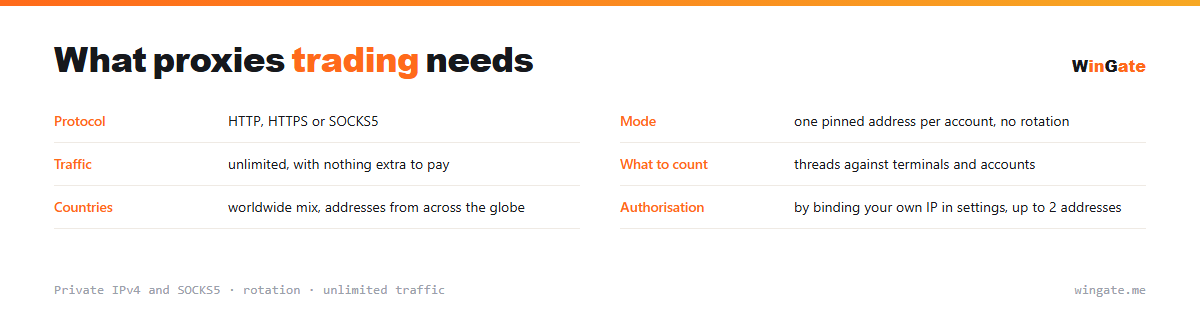
Features of proxies for trading
In trading, proxies give access to exchanges and terminals and separate several trading accounts, and low ping directly affects order execution. A delay or drop costs money.
You get private IPv4 over HTTP, HTTPS or SOCKS5, as IP:PORT bound to your IP or as IP:PORT:LOGIN:PASS. Every account keeps its own fixed IP, and the package is chosen by the number of terminals, since traffic here is light.
What proxies you need for trading
| Protocol | HTTP, HTTPS or SOCKS5 |
|---|---|
| Mode | one pinned address per account, no rotation |
| Traffic | unlimited |
| What to count | threads per terminal and account |
| Countries | worldwide mix of countries |
| Authorization | by binding your own IP in settings, up to 2 addresses |
Which proxies trading needs
The load looks more like a constant connection than bulk collection: little traffic, but a dropped connection costs more than latency. So choose the package by the number of threads your terminals and accounts need, since traffic is unlimited anyway.
Rotation is counterproductive here. Exchanges and brokers tie an account to the IP it usually logs in from, and a sudden change mid-session triggers extra verification. Each account stays on one fixed IP, and the IP:PORT:LOGIN:PASS format is handy because you can use it on different machines.
A similar case with a constant connection is covered on the page about pool connections.
- A dropped connection costs more than latency
- One fixed IP per account, rotation only gets in the way
- Choose the package by the number of terminals and accounts
How to set up proxies for trading
To use the pool, bind the IP of the machine that runs your proxy software (a server or a home PC) in the settings. No binding, no access. The main format is IP:PORT, plus IP:PORT:LOGIN:PASS for programs that require a login and password.
For trading, proxies are set in the terminal, trading bot or system settings, in IP:PORT format, HTTP or SOCKS5, one address per account.
Check ping and stability before you start trading. The free test lets you see how well the address holds the connection to the exchange.
How to buy proxies for trading
The process is simple. Sign up in the dashboard, request a free test of up to 2 hours, bind your IP and message support through a ticket to check the setup on your own trading tasks.
Then just choose a plan by volume and term and pay in crypto; access opens right away. Take the free test first; it is available once. Support handles questions in tickets.
FAQ
Will these proxies work for trading?
For API work, collecting quotes and running several accounts, you can use HTTP, HTTPS or SOCKS5 in IP:PORT format. The free test shows whether it fits.
Is the connection stable?
At the core is a private IPv4 pool with low ping, which matters for the API and terminals. The free test will show how stable the connection is for your task.
Can I choose the address country?
You get a rotating pool of private IPv4 from networks around the world. The test will show whether this works for your task.
See also: buy proxies for traffic arbitrage, buy proxies for mining, buy proxies for airdrops, buy proxies for email campaigns, buy proxies for Telegram, buy proxies for Instagram, buy proxies for GoLogin, buy proxies for SMM, full catalog
© WinGate · source of the material · wingate.me/en/proxy/trading-proxy