Proxies for AI
A pool of private IPv4 and SOCKS5 for AI APIs.
Proxy plans for AI
Every plan includes both IPv4 and SOCKS5.
Threads are simultaneous connections. The more threads, the higher the parallel load your software can handle.

Pool of 12,000-15,000 IPs
Address rotation
Unlimited traffic
Up to 1,000 threads

Pool of 12,000-15,000 IPs
Address rotation
Unlimited traffic
Up to 1,000 threads

Pool of 12,000-15,000 IPs
Address rotation
Unlimited traffic
Up to 1,000 threads

Pool of 12,000-15,000 IPs
Address rotation
Unlimited traffic
Up to 1,000 threads
Pool of 12,000-15,000 IPs
Address rotation
Unlimited traffic
Up to 3,000 threads
Pool of 12,000-15,000 IPs
Address rotation
Unlimited traffic
Up to 3,000 threads
Pool of 12,000-15,000 IPs
Address rotation
Unlimited traffic
Up to 3,000 threads
Pool of 12,000-15,000 IPs
Address rotation
Unlimited traffic
Up to 3,000 threads
Proxy catalog for your task
Why you need proxies for AI
AI tools are used via the API and across several accounts, with parallel requests and background monitoring. When all requests come from one address, the service quickly rate-limits you.
Access to an AI service depends on two things: where the request comes from and how often you send it. Services cap the request rate to their interface, so a pool spreads that load across thousands of addresses.
What to know about proxies for AI
Many AI services (ChatGPT, Claude, Midjourney) are not available in every region and watch for suspicious IPs, and if you run several accounts, each one needs its own address.
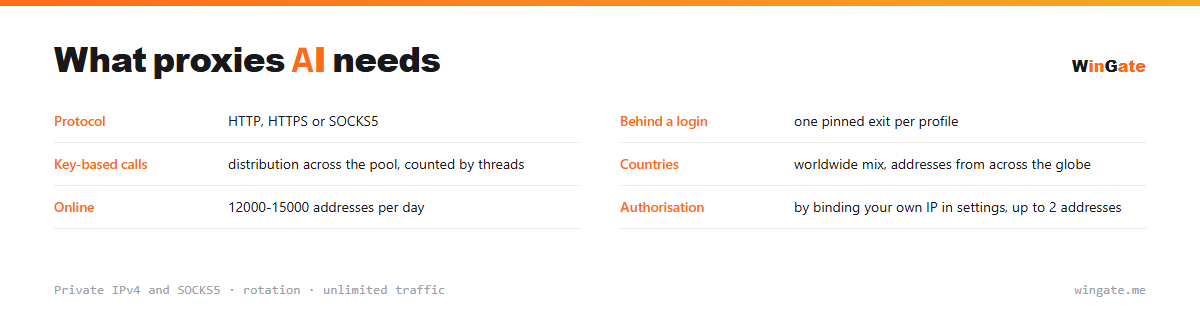
You get private IPv4 over HTTP, HTTPS or SOCKS5, as IP:PORT bound to your IP or as IP:PORT:LOGIN:PASS. A logged-in profile stays on one pinned IP, and API key requests spread across the pool, sized by thread count.
What proxies you need for AI tools
| Protocol | HTTP, HTTPS or SOCKS5 |
|---|---|
| Behind a login | one pinned IP per profile |
| API key requests | spread across the pool, sized by threads |
| Countries | worldwide mix of countries |
| Online | 12,000-15,000 IPs online daily |
| Authorization | by binding your own IP in settings, up to 2 addresses |
Proxies for AI tools: browser sessions and API key requests
Sort this out up front, because it decides how many addresses you need. Working in the browser means a logged-in session: each profile keeps one pinned IP, because an IP change mid-session looks like a hacked account. API key requests, on the other hand, spread across the pool just fine.
In the second case, the number of addresses depends on how many threads run at once. If all threads share one IP, it takes the whole request load, hits the limit first and drags down overall throughput.
Technically, all ports are open, and you use whichever protocol your software supports. Specific cases are covered on the pages about ChatGPT and Midjourney.
- Logged-in sessions need a pinned address; rotation gets in the way
- API key requests spread across the pool easily
- Size addresses by thread count
How to set up proxies for AI
To connect to the pool, go to the settings and bind the IP of the server or home computer where your proxy software runs. Without this binding the proxies will not work. There are two formats: the standard IP:PORT and IP:PORT:LOGIN:PASS for programs that need login and password fields.
For AI services, set the proxy in your system settings, in an antidetect profile or in the API request code (the proxy parameter): IP:PORT format, HTTP or SOCKS5.
Check the setup when you log in. The free test shows how stable the connection to your AI service is.
How to buy proxies for AI
The process is simple. Sign up in the dashboard, request a free test of up to 2 hours, bind your IP and open a ticket with the operator to test the setup on your own tasks.
If everything works, choose a package by volume and term, pay in crypto, and access opens right after payment. The free test runs once, before you pay. Support answers in tickets.
FAQ
Will these proxies work for AI?
For API work and multiple accounts, HTTP, HTTPS and SOCKS5 in IP:PORT format all work. The free test shows whether it fits your task.
How many parallel requests can the pool handle?
The number of parallel sessions and bindings depends on the package; the pool of 12,000-15,000 IPv4 gives requests different addresses.
Can I choose the address country?
You get a rotating pool of private IPv4 from networks around the world. The free test shows whether this fits your task.
See also: proxies for ChatGPT, proxies for Midjourney, proxies for BAS, proxies for Selenium, proxies for Puppeteer, proxies for Python scripts, proxies for airdrops, proxies for Meta Ads, full catalog
© WinGate · source of the material · wingate.me/en/proxy/ai-proxy