Proxies for Python scripts
Private addresses for Python scripts and bots.
Proxy plans for Python scripts
Every plan includes both IPv4 and SOCKS5.
Threads are simultaneous connections. The more threads, the higher the parallel load your software can handle.

Pool of 12,000-15,000 IPs
Address rotation
Unlimited traffic
Up to 1,000 threads

Pool of 12,000-15,000 IPs
Address rotation
Unlimited traffic
Up to 1,000 threads

Pool of 12,000-15,000 IPs
Address rotation
Unlimited traffic
Up to 1,000 threads

Pool of 12,000-15,000 IPs
Address rotation
Unlimited traffic
Up to 1,000 threads
Pool of 12,000-15,000 IPs
Address rotation
Unlimited traffic
Up to 3,000 threads
Pool of 12,000-15,000 IPs
Address rotation
Unlimited traffic
Up to 3,000 threads
Pool of 12,000-15,000 IPs
Address rotation
Unlimited traffic
Up to 3,000 threads
Pool of 12,000-15,000 IPs
Address rotation
Unlimited traffic
Up to 3,000 threads
Proxy catalog for your task
Why you need proxies for Python scripts
In Python scripts with requests, aiohttp or Scrapy, collection and automation often run in several threads. When everything comes from one address, sites respond with captchas and slow you down.
In a script, a proxy takes two lines of code, so the mistakes here are small: the wrong address scheme, forgotten name resolution, and one IP shared by every thread. Those three are worth going through in order.
Features of proxies for Python scripts
In Python scripts (requests, aiohttp, Scrapy) a proxy is needed when the script makes many requests and the site starts limiting by IP. A rotating pool lets you send requests asynchronously from different addresses.
You get private IPv4 over HTTP, HTTPS or SOCKS5, as IP:PORT bound to your IP or as IP:PORT:LOGIN:PASS. The credential format drops straight into a connection string, and binding your own IP is required in either case.
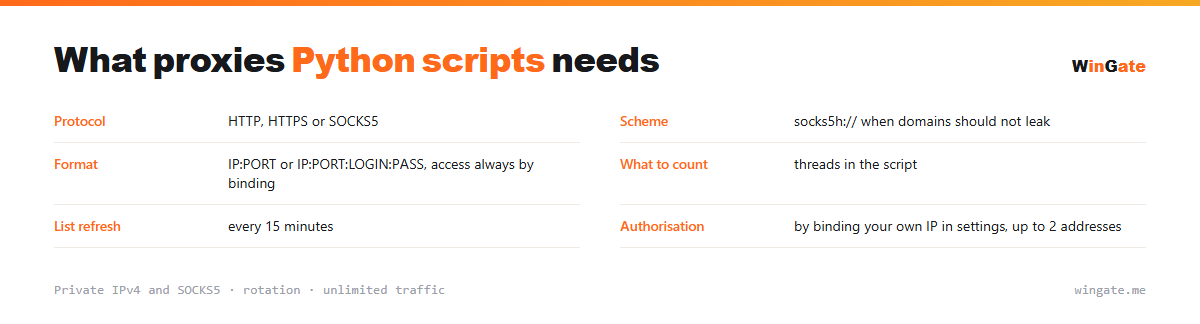
What proxies you need for Python scripts
| Protocol | HTTP, HTTPS or SOCKS5 |
|---|---|
| Setup | socks5h:// when domains should not leak |
| Format | IP:PORT or IP:PORT:LOGIN:PASS, access via IP binding only |
| What to count | threads in the script |
| List refresh | every 15 minutes |
| Authorization | by binding your own IP in settings, up to 2 addresses |
How to connect a proxy in a Python script
First, the scheme. Written as socks5://, a hostname is resolved on the script's side, so the query bypasses the proxy and stays visible to your provider. Written as socks5h://, the proxy resolves it. It is a one-letter difference, and it decides whether your DNS queries leak.
Second, sessions. Opening a new connection per request costs more than speed: it also loses the fixed IP you need when working behind a login. A persistent session on one fixed IP solves both, and rotation is for jobs that do not need a login.
Third, distribution. One IP shared by the whole thread pool takes all the requests and gets blocked first. Get enough addresses for the number of threads you run at once, plus some spare, and re-read the list on a schedule, since it refreshes every 15 minutes. The same principles apply through Selenium and Puppeteer.
- socks5h:// resolves hostnames on the proxy side, socks5:// on yours
- A new connection per request loses the fixed IP
- One IP shared by every thread gets blocked first
How to set up proxies for Python scripts
Access opens once you bind your IP in the settings. That is the address of the server or home computer where your software runs; without it, nothing will connect. It comes in two formats: IP:PORT as the main one, and IP:PORT:LOGIN:PASS for programs with login and password fields.
In Python the proxy is passed in the proxies parameter (requests) or in Scrapy/aiohttp settings in the format http://LOGIN:PASS@IP:PORT or socks5://..., and the list is easy to rotate in code.
Test the setup on a couple of requests first. The free test will show how many addresses you need for your load.
How to buy proxies for Python scripts
The process is simple. Sign up in the dashboard, request a free test of up to 2 hours, bind your IP and message support through a ticket to check the setup with your own Python scripts.
If everything works for you, choose a package by volume and term, pay in crypto, and access is activated automatically. One free test is available before purchase. For setup questions, open a ticket with support.
FAQ
Will these proxies work with Python scripts?
Python takes a proxy through request parameters in HTTP, HTTPS and SOCKS5, and our IP:PORT format works as is. The free test shows whether it fits.
How many threads can I run?
The number of threads and IP bindings depends on the package, and the pool of 12,000-15,000 IPv4 gives each session a different address.
Which protocol should I choose, HTTP or SOCKS5?
Both work for most tasks; SOCKS5 is handier for non-standard connections. You can check both during the free test.
See also: proxies for BAS, proxies for Selenium, proxies for Puppeteer, proxies for ZennoPoster, proxies for AMS Enterprise, proxies for A-Parser, proxies for ChatGPT, proxies for checkers, full catalog
© WinGate · source of the material · wingate.me/en/proxy/python-proxy