Rotating private IPv4 proxies
Rotation across the pool, private IPv4 and SOCKS5.
Rotating proxy plans
Every plan includes IPv4 and SOCKS5 together, at no extra cost.
Threads are simultaneous connections. The more threads, the higher the parallel load your software can handle.

Pool of 12,000-15,000 IPs
Address rotation
Unlimited traffic
Up to 1,000 threads

Pool of 12,000-15,000 IPs
Address rotation
Unlimited traffic
Up to 1,000 threads

Pool of 12,000-15,000 IPs
Address rotation
Unlimited traffic
Up to 1,000 threads

Pool of 12,000-15,000 IPs
Address rotation
Unlimited traffic
Up to 1,000 threads
Pool of 12,000-15,000 IPs
Address rotation
Unlimited traffic
Up to 3,000 threads
Pool of 12,000-15,000 IPs
Address rotation
Unlimited traffic
Up to 3,000 threads
Pool of 12,000-15,000 IPs
Address rotation
Unlimited traffic
Up to 3,000 threads
Pool of 12,000-15,000 IPs
Address rotation
Unlimited traffic
Up to 3,000 threads
Proxy catalog for your task
Why rotation matters
Rotation earns its place wherever a task fires a lot of similar requests. When every thread exits from one address, the platform links them together and starts applying limits.
Rotation exists for one reason: to stop any single address from reaching the request rate at which a platform stops answering. The list refreshes every 15 minutes, so fresh nodes keep entering the job and the load spreads across thousands of addresses instead of one.
Features of rotating proxies
Rotation covers 12,000 to 15,000 private IPv4 from various countries in worldmix. IPv4 or SOCKS5 to choose from, HTTP, HTTPS and SOCKS5 protocols, and unlimited traffic.
Rotation happens across the pool, so there is no separate switch to configure. Speed and low ping hold up under load, which keeps multi-threaded jobs from stalling.
How rotation works in the pool
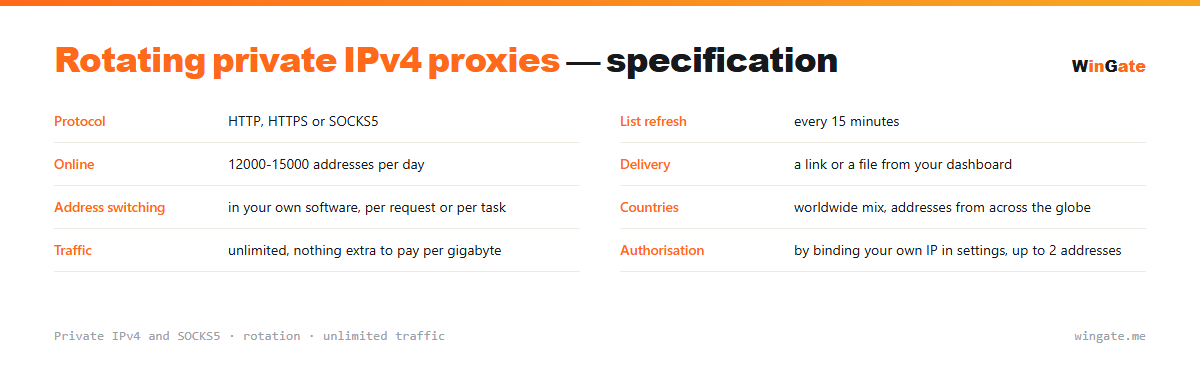
| Protocol | HTTP, HTTPS or SOCKS5 |
|---|---|
| List refresh | every 15 minutes |
| Online | 12000-15000 addresses per day |
| Delivery | a link or a file from your dashboard |
| Address switching | in your own software, per request or per task |
| Countries | worldwide mix, addresses from across the globe |
| Traffic | unlimited, nothing extra to pay per gigabyte |
| Authorisation | by binding your own IP in settings, up to 2 addresses |
How proxy rotation works in the pool
Rotation here is not a switch in an interface, it is the composition of the list itself. Software that re-reads the list on a schedule keeps working with fresh addresses without stopping the job.
Switching address from request to request happens on your side, which is the right place for it, because only you know where it helps and where it hurts. Open collection takes the next address on every request. Work behind a login is the opposite: one address is pinned to the account and held, because an IP jump inside a session reads as a compromised account.
Count addresses against threads. With fifty threads and ten addresses, every exit carries five times the load and burns out first. The reverse arrangement, with headroom, lets you hold the overall pace without pushing the request rate on any single address.
Request rhythm counts for as much as rotation itself. Intervals spaced evenly to the fraction of a second read as automation even when every request leaves from its own address, so a spread is built into the pauses. The opposite case exists too: unusually sparse visits from a constantly changing address look odd wherever a live session is expected.
- Per-request address switching happens in your software
- Rotation hurts behind a login, where a pinned address is needed
- Count addresses against threads
How to set up rotating proxies
Access opens by binding the IP of the server or home-network computer where the proxy software runs, up to 2 addresses. Without that binding the proxy will not work in any format.
The main output format is IP:PORT, and for programs with login and password fields there is an additional IP:PORT:LOGIN:PASS. It is easy to check the pool against your own task on the free test up to 2 hours.
How to buy rotating proxies
Sign up in the cabinet and request the free test up to 2 hours, bind your IP and message an operator in a ticket to run the pool against your own tasks.
Once it suits you, pick a package by volume and term, pay in crypto, and access is activated automatically after the payment.
FAQ
How often do addresses change?
The pool runs in rotation, so requests spread across 12,000 to 15,000 IPv4. How that looks on your own task is clear on the free test.
Do I need to configure rotation in my software?
The spread happens across the pool on our side, so it works out of the box. Your program only takes the issued address and port.
Does rotation work for sessions?
Session-bound work takes one address for the whole sequence, while mass requests are easier with rotation. Both scenarios run on the test.
See also: private proxies, IPv4 proxies, buy proxies for scraping, buy proxies for checkers, buy proxies for ZennoPoster, full catalog
© WinGate · source of the material · wingate.me/en/proxy/rotating-proxies