Private proxies with rotation
Private proxies in one hand, with rotation and low ping.
Private proxy plans
Every plan includes IPv4 and SOCKS5 together, at no extra cost.
Threads are simultaneous connections. The more threads, the higher the parallel load your software can handle.

Pool of 12,000-15,000 IPs
Address rotation
Unlimited traffic
Up to 1,000 threads

Pool of 12,000-15,000 IPs
Address rotation
Unlimited traffic
Up to 1,000 threads

Pool of 12,000-15,000 IPs
Address rotation
Unlimited traffic
Up to 1,000 threads

Pool of 12,000-15,000 IPs
Address rotation
Unlimited traffic
Up to 1,000 threads
Pool of 12,000-15,000 IPs
Address rotation
Unlimited traffic
Up to 3,000 threads
Pool of 12,000-15,000 IPs
Address rotation
Unlimited traffic
Up to 3,000 threads
Pool of 12,000-15,000 IPs
Address rotation
Unlimited traffic
Up to 3,000 threads
Pool of 12,000-15,000 IPs
Address rotation
Unlimited traffic
Up to 3,000 threads
Proxy catalog for your task
Why you need private proxies
Private proxies are addresses that are not shared between customers. The reputation of each IP depends only on your work.
The word private here describes who else uses the addresses. The pool stays closed to clients of the service, so the history behind an address is not smeared across thousands of unrelated jobs and the request load on it stays within what you set.
Features of private proxies
Our pool holds 12,000 to 15,000 IPv4 in rotation, addresses from various countries in worldmix, IPv4 or SOCKS5 to choose from. Traffic is unlimited, so no gigabyte counter gets in the way.
The key working advantage is speed and low ping. On scraping and multi-threaded automation, response time drives real throughput more than pool size does.
What the private pool gives you
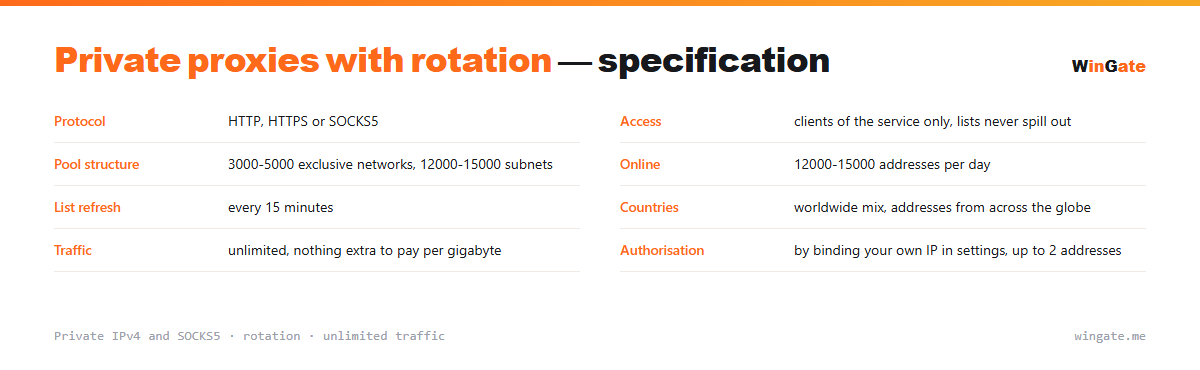
| Protocol | HTTP, HTTPS or SOCKS5 |
|---|---|
| Access | clients of the service only, lists never spill out |
| Pool structure | 3000-5000 exclusive networks, 12000-15000 subnets |
| Online | 12000-15000 addresses per day |
| List refresh | every 15 minutes |
| Countries | worldwide mix, addresses from across the globe |
| Traffic | unlimited, nothing extra to pay per gigabyte |
| Authorisation | by binding your own IP in settings, up to 2 addresses |
How private proxies differ from shared lists
The gap between private and public access shows up in success rate. Free and shared lists are pulled by thousands of people at once, and the same addresses are harvested by services and sold on as their own. By the time a list reaches you, platforms have already seen those addresses inside automated traffic, and the threshold for flagging them has dropped.
A private pool works differently: the networks are reachable only from inside the service and the addresses never spill into open sources. That is no guarantee against blocks, but a platform starts from a different level of trust, and across volume the gap adds up.
Structure deserves a look of its own. Spread across networks counts for more than raw address count: a pool sitting inside one range gets closed off by a single anti-bot rule.
The delivery format follows your software. Access opens by binding either way: your own IP goes into the dashboard settings, and without it the list will not work in any format.
- Public lists get resold as if they were unique
- Private networks are reachable only from inside the service
- Spread across subnets matters more than raw address count
How to set up private proxies
Access opens by binding the IP of the server or home-network computer where the proxy software runs, up to 2 addresses. Without that binding the proxy will not work in any format.
The main output format is IP:PORT, and for programs with login and password fields there is an additional IP:PORT:LOGIN:PASS. It is easy to check the pool against your own task on the free test up to 2 hours.
How to buy private proxies
Sign up in the cabinet and request the free test up to 2 hours, bind your IP and message an operator in a ticket to run the pool against your own tasks.
Once it suits you, pick a package by volume and term, pay in crypto, and access is activated automatically after the payment.
FAQ
How do private proxies differ from shared ones?
A private address is issued to one owner, so its reputation depends only on your work. Shared lists are used by many at once and run into limits fast.
How many addresses are in the pool?
Rotation runs across 12,000 to 15,000 IPv4 from various countries. The pool refreshes, so threads do not collide on a single address.
Do I need a login and password?
Access opens by binding your IP in the settings, up to 2 addresses. Login and password is only an additional output format for software with those fields.
See also: private IPv4 proxies, SOCKS5 proxies, anonymous proxies, buy proxies for scraping, buy proxies for multi-accounting, full catalog
© WinGate · source of the material · wingate.me/en/proxy/private-proxies